
Finding a decent spot to spin the reels shouldn’t feel like a chore. If you’re sick of waiting days for your winnings, PayID pokies are the way to go.
We’ve spent weeks depositing, playing, and cashing out at the best Aussie-friendly platforms that accept PayID. No credit cards, no stress—just fast hits and faster payouts using your phone number or email.
Whether you’re chasing progressive jackpots or after a quick spin on the latest Megaways titles, our top PayID pokies picks below have been tested for speed, security, and real player value in 2026.
The Best PayID Pokies: First Look


Here are our top 5 picks reviewed in detail below. Every review includes our actual deposit, gameplay, and cashout experience—no guesswork involved.
1. Neospin – Fast Withdrawals

Bonus: Up to A$10,000 + 100 FS | Wagering: 40x | Payout Speed: Instant | License: Curacao
Pros:
- Truly instant PayID payouts
- Huge $10k bonus potential
- Daily cashback up to 20%
- Excellent search filters
Cons:
- Fewer free spins than competitors
Neospin tops our list of PayID pokies sites for one simple reason: nobody pays faster. The entire banking system is engineered around speed, and Aussie punters using PayID will notice the difference immediately compared to other platforms.
The $10,000 welcome bonus cap is massive for anyone who wants to start big. Pair that with a daily cashback of up to 20%, and rough sessions don’t sting as much. The game library is well-organised with filters by provider, volatility, and RTP—handy for punters who know exactly what they want.
Our Test: I dropped $200 via PayID on a Thursday afternoon. Balance updated within 15 seconds. Spent two hours on Bonus Buy pokies (the “skip to feature” titles that cut straight to the action). After a lucky streak on a fruit-themed game, I withdrew $450. The bank notification arrived in under ten minutes. That kind of turnaround keeps Neospin firmly at number one on our list in Australia.
The interface is sharp on both desktop and mobile. I also tested their cashback: lost $80 on a Friday, woke up Saturday with $16 back in my balance. No claim button needed—it just appeared.
2. GoldenCrown – VIP Players

Bonus: Up to A$10,000 + 100 FS | Wagering: 40x | Payout Speed: 0-24 Hours | License: Curacao
Pros:
- Massive four-deposit welcome package
- Strong VIP loyalty tiers
- 6,000+ game titles
- No-fee PayID transactions
Cons:
- VIP perks kick in after a few weeks
GoldenCrown caters to punters who plan to stick around. The welcome bonus spreads across four deposits, so you don’t need to front-load your bankroll on day one. Over 6,000 online pokies from providers like Pragmatic Play, Nolimit City, and Push Gaming fill the lobby.
The VIP programme runs on a points system. Every real-money spin earns loyalty credits, redeemable for bonus funds, free spins, or cashback. Higher tiers unlock faster withdrawals and a personal account manager—useful when you need a payout sorted outside normal hours.
Our Test: Signed up on a Monday, deposited $150 with PayID. Took about 20 seconds to land. I spread my play across three days testing different providers. The search function works well—typing “Megaways” pulled up 80+ titles immediately. My first withdrawal of $320 took around 8 hours to process, which improved to under 4 hours by my third cashout (likely because verification was already done). GoldenCrown is a strong pick if you value variety and long-term rewards.
3. Skycrown – Game Variety
Bonus: Up to A$4,000 + 400 FS | Wagering: 40x | Payout Speed: 1-2 Hours | License: Curacao
Pros:
- 6,000+ games available
- No-fee PayID transactions
- Great themed collections
- 24/7 live support
Cons:
- Navigation takes getting used to
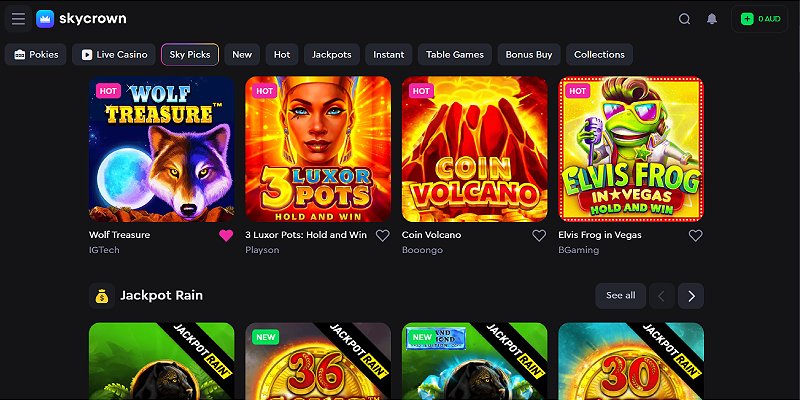
Skycrown is the one you go to when you’re bored of the same 200 pokies on every other site. They stock titles from dozens of providers, sorted into themed collections—Egypt, Books, Fruits, Megaways—which actually makes the enormous catalogue browsable rather than overwhelming.
The welcome deal spreads $4,000 and 400 spins across your first five deposits. PayID works both ways here (deposit and withdrawal), and the processing fees are zero. Live chat runs around the clock and our test queries got answered within 90 seconds.
Our Test: Five hours disappeared testing Skycrown’s library. Deposited $50 via PayID, credited instantly. The “Collection” feature was genuinely useful—I found three pokies I’d never seen before in the “Mythology” section. Tried a couple of live dealer games too; stream quality was solid with no buffering on my home wi-fi. Withdrawal hit my ANZ account in just under two hours. That’s impressive for a site this size.
4. Wild Tokyo – Loyalty Rewards

Bonus: Up to A$4,200 + 500 FS | Wagering: 50x | Payout Speed: 0-24 Hours | License: Curacao
Pros:
- Unique loyalty shop system
- Cool futuristic theme
- Strong Megaways selection
- Fast daily withdrawals
Cons:
- 50x wagering is on the higher side
Wild Tokyo wraps the whole experience in a neon cyberpunk theme. Beyond the aesthetics, the real draw is the “Shop” system: every spin earns coins you can trade for bonus funds, free spins, or even gadgets. Regular players accumulate coins without thinking about it, and the redemption options are genuinely useful (not just cosmetic junk).
The $4,200 welcome package splits across three deposits. Megaways titles load smoothly—the backend handles thousands of paylines without frame drops even on older devices. The 50x wagering is higher than average, but the cashback and loyalty shop offset it for anyone who plays consistently.
Our Test: Signed up, deposited $100 via PayID. Focused on Megaways pokies for two sessions over a weekend. The coin system tracked my play automatically—by Sunday I had enough for 20 free spins in the shop. Cashed out $280 on Sunday evening; PayID transfer arrived before I finished cooking dinner (roughly 90 minutes). Wild Tokyo nails the gamified approach without making it feel gimmicky.
5. Gambiva – Live Casino Pokies

Bonus: 150% up to A$750 + 50 FS | Wagering: 35x | Payout Speed: 0-24 Hours | License: Curacao
Pros:
- Strong live dealer section alongside pokies
- Low 35x wagering requirement
- Clean, modern interface
- Fast PayID processing
Cons:
- Smaller welcome bonus than competitors
Gambiva positions itself at the intersection of pokies and live casino. The pokie selection covers the usual suspects—Pragmatic Play, BGaming, Play’n GO—but the live dealer lobby is where Gambiva stands apart. For punters who like to mix pokies sessions with a few rounds of live online blackjack or roulette, having both under one roof is convenient.
The 35x wagering on the welcome bonus is lower than most, which means bonus funds convert to real cash faster. PayID deposits are processed through a clean, intuitive cashier that doesn’t bury the option behind three menus.
Our Test: Deposited $100, got $150 bonus plus 50 spins. Spent an hour on pokies, then switched to live blackjack—the transition was seamless. Cleared the wagering in about four hours of mixed play (the low 35x helps). PayID withdrawal of $215 arrived next morning. Gambiva won’t blow you away with bonus size, but the low wagering and mixed gameplay make it a practical pick for players.
How We Ranked the Best PayID Pokies
PayID Integration
We don’t just check if the PayID logo appears on the payments page. We deposit and withdraw using real CommBank, NAB, and ANZ accounts to confirm the plumbing actually works. If a site takes three days to move your money, it doesn’t make this list.
We specifically time how long deposits take to appear in the gaming balance (anything over 60 seconds is a red flag) and how long withdrawal requests take from approval to arriving in the bank account. Sites that offer PayID for deposits but force bank transfers for withdrawals get marked down significantly.
Licensing & Security
Every site on our list holds a recognised licence from Curacao or Kahnawake. We verify these directly with the regulators and check for current SSL encryption protecting your PayID details and personal information.
We also look at how each site stores your data. Two-factor authentication, session timeouts, and encrypted communications between you and the PayID gateway all factor into our safety score. A site can have the best pokies library in the world—if the security doesn’t hold up, we won’t list it.
Pokie Variety & RTP
A pokies site is only as good as its games. We look for a mix of classic 3-reels, Megaways, progressives, and Bonus Buy titles. RTP percentages are checked against published figures to ensure fair odds.
Provider diversity matters too. A site carrying Pragmatic Play, NetEnt, Evolution, Play’n GO, Nolimit City, and Push Gaming gives you a far broader range of mechanics and volatility levels than one locked into a single provider. We check that the listed RTPs match the actual game info screens—some sites display inflated numbers on their marketing pages.
Mobile Performance
Most Aussie punters play on their phones. We test every site on both iOS and Android, checking load times, touch responsiveness, and whether the PayID cashier functions properly on smaller screens.
We run tests on both wi-fi and 4G to see how games perform on slower connections. A site that loads perfectly at home but stutters on mobile data isn’t truly mobile-friendly. We also check whether the full game library is available on mobile or if certain titles are desktop-only.
Customer Support
When something goes wrong with a payout, you need fast answers. We test live chat and email at every site, looking for response times under two minutes and staff who actually understand PayID-specific queries.
We ask deliberate questions about PayID processing times, wagering calculations, and withdrawal limits to see if the agents know what they’re talking about. A fast but useless response is worse than waiting five minutes for someone who can actually solve your problem.
Bonus Fairness
Welcome bonuses look impressive in headlines, but the terms determine whether they’re actually worth claiming. We evaluate wagering requirements (anything over 45x is steep), game contribution rates (do pokies count 100%?), maximum bet limits during wagering, and withdrawal caps on bonus winnings.
A $10,000 bonus with 60x wagering and a $500 withdrawal cap is worse than a $500 bonus with 35x wagering and no cap. We factor in the realistic value, not just the advertised number.
What Are PayID Pokies?

PayID pokies are online pokie games at sites that accept Australia’s PayID payment system for deposits and withdrawals. PayID links your bank account to a simple identifier—usually your phone number or email address—allowing you to transfer AUD to and from a pokies site without sharing your actual bank details.
The main advantage over traditional bank transfers is speed. Most PayID pokies deposits are instant, and withdrawals typically process within minutes to hours rather than the 3-5 business days you’d wait with a standard bank transfer. The system is operated by NPP Australia and supported by all major banks including CommBank, Westpac, NAB, and ANZ.
PayID was originally designed for person-to-person transfers between Australian bank accounts. The technology uses the New Payments Platform (NPP), which settles transactions in real time rather than batching them overnight like the old BPAY and direct debit systems. When applied to online casinos, this means your deposit arrives before the page finishes loading—and your withdrawal doesn’t sit in a queue waiting for a batch processing window.
How PayID Works Behind the Scenes
When you send a PayID payment, your bank routes the transaction through the NPP network, which verifies the recipient’s PayID identifier against their registered bank account. The entire process completes in under 30 seconds. For online pokies sites, this means the site receives confirmed funds (not just a pending transfer) almost immediately, which is why they can credit your balance so fast.
The security layer works in your favour: the pokies site never sees your BSB, account number, or card details. They receive funds tagged with your PayID identifier (phone or email) and a transaction reference. If you ever need to dispute a payment, your bank has a complete audit trail through the NPP.
PayID vs Other Payment Methods for Pokies
The speed difference is significant. A credit card deposit typically processes in 1-5 minutes (with additional verification for first-time transactions). A bank transfer can take 1-3 business days. PayID consistently delivers under 30 seconds in our testing.
For withdrawals, the gap widens further. Credit card refunds can take 3-7 business days. Bank transfers average 2-5 days. PayID withdrawals at our top-rated sites arrive within minutes to hours. Neospin consistently delivered in under 10 minutes during our testing period.
Why Use PayID for Pokies?

Instant Deposits
No pending transfers. Your AUD hits the pokies site immediately, so you can start spinning within seconds of initiating the transfer from your banking app. Unlike card payments that can get flagged for additional verification on gambling sites, PayID transfers complete without friction because they’re treated as standard bank-to-bank transfers.
Enhanced Privacy
Sites on our list only receive your PayID identifier (phone number or email), not your BSB, account number, or card details. Your core banking information stays private. This is particularly valuable for punters who don’t want gambling transactions appearing on credit card statements or who prefer to keep their gaming activity separate from their primary payment methods.
Zero Fees
Australian banks and the sites on our list don’t charge transaction fees for PayID. Every dollar you deposit goes toward your bankroll, not processing charges. Compare this to credit cards (which can attract cash advance fees of 2-3% at some sites) or crypto exchanges (which charge network fees on every transfer). PayID is genuinely free in both directions.
Real-Time Withdrawals
The best sites on our list process cashouts in minutes. Neospin consistently delivered under 10 minutes during our testing—far ahead of any card-based method. Even the slower sites on our list processed PayID withdrawals within 24 hours, which beats the industry standard of 3-5 business days for traditional banking methods.
No Chargebacks for Sites
This benefits you indirectly. Because PayID transfers are irrevocable (like cash), pokies sites don’t need to worry about chargeback fraud. As a result, they process PayID withdrawals faster than card withdrawals, where they typically hold funds for 48-72 hours as a fraud prevention measure. Your money moves quicker because the site has less risk.
Highest Paying Games at PayID Pokies Sites
Mega Joker (RTP: 99%)
A classic fruit machine with a supermeter mode that pushes returns above 99% at max bet. The catch is you need to play at maximum stake to access the supermeter, which is where the high payout RTP kicks in. At lower bets, the RTP drops significantly. Available at Neospin and Skycrown. Best suited for players who understand variance and are comfortable with all-or-nothing mechanics.
Blood Suckers (RTP: 98%)
Vampire-themed, low volatility, frequent small wins. This is the go-to game for clearing wagering requirements because the low variance means your balance stays relatively stable while you work through the playthrough. The bonus round triggers often enough to keep things moving. Stocked at GoldenCrown and National Casino.
1429 Uncharted Seas (RTP: 98.5%)
Hand-drawn art style with expanding wilds that can cover entire reels. The medium-low volatility delivers a steady stream of wins without the feast-or-famine swings of high-variance games. Patient players who don’t mind smaller but more frequent payouts will appreciate the consistency. Find it at Skycrown and DragonSlots.
Starmania (RTP: 97.87%)
Space-themed game that pays both ways across the reels, effectively doubling your win lines compared to standard left-to-right pokies. The expanding wilds can create some impressive combinations on good runs. Available at National Casino and Kingdom Casino—a reliable choice for extended sessions.
Book of 99 (RTP: 99%)
Another ultra-high RTP title that lives up to the name. The “book” mechanic triggers expanding symbols during free spins, and the base game return is genuinely close to 99% over a large sample. Available at Skycrown and Gambiva. One of the best options for bonus wagering because the maths work in your favour over longer sessions.
White Rabbit Megaways (RTP: 97.72%)
Up to 248,832 ways to win through the extending reels mechanic. The Feature Drop option lets you buy directly into the bonus round, skipping the base game grind entirely. High variance means big swings, but the potential payouts are enormous. Available at GoldenCrown and DragonSlots for punters who want maximum excitement.
Complete Guide to PayID Pokies Bonuses
Understanding Wagering Requirements
Every bonus comes with a wagering requirement—the number of times you need to bet the bonus amount before you can withdraw winnings. A $100 bonus with 40x wagering means you need to place $4,000 in total bets before cashing out. This doesn’t mean you need to lose $4,000; every spin counts toward the requirement regardless of whether you win or lose.
At an average RTP of 96%, you’d theoretically have about $100 remaining after completing wagering on a $100 bonus with 40x playthrough. The lower the requirement, the more likely you are to have real money left to withdraw.
Game Contribution Rates
Not all games contribute equally to wagering. Most sites count pokies at 100%, meaning every dollar bet on a pokie clears one dollar of wagering. Table games typically contribute 10-20%, and live dealer games sometimes contribute 0%. Always check the bonus terms to avoid spinning your wheels on games that don’t count.
Bonus Types Explained
Match bonus: The site matches your deposit by a percentage. A 100% match on $100 gives you $100 extra to play with.
Free spins: A set number of spins on specific pokies at a predetermined bet size. Winnings from free spins usually carry their own wagering requirements (often 30-50x the winnings, not the spin value).
No-deposit bonus: Small amounts ($5-$20) or free spins given just for signing up. Great for testing a site, but wagering requirements are typically higher (60x+) and withdrawal caps are tight ($50-$100).
Cashback: A percentage of your net losses returned to your balance. Usually ranges from 5-20% depending on VIP tier. The best cashback offers (like Neospin’s) come with no additional wagering requirement—you get real cash back, not bonus funds.
How to Calculate Real Bonus Value
Take the bonus amount, subtract the expected loss from wagering (based on the game RTP and wagering multiple), and factor in any withdrawal cap. A $500 bonus with 35x wagering on pokies averaging 96% RTP has an expected value of roughly $120-150 in withdrawable cash. A $10,000 bonus with 50x wagering might have the same expected value due to the higher playthrough.
Bonuses at a Glance
| Site | Welcome Bonus | Wagering | Free Spins | Cashback |
|---|---|---|---|---|
| Neospin | A$10,000 | 40x | 100 FS | Up to 20% |
| GoldenCrown | A$10,000 | 40x | 100 FS | VIP tiers |
| Skycrown | A$4,000 | 40x | 400 FS | Available |
| Wild Tokyo | A$4,200 | 50x | 500 FS | Coin shop |
| Gambiva | A$750 | 35x | 50 FS | Available |
Payment Methods at PayID Pokies Sites
PayID
The primary method for Australian punters. Links your bank account via phone number or email—instant deposits, fast withdrawals, zero fees. Every site on this list supports PayID for both directions.
To set up PayID for the first time, open your banking app (CommBank, NAB, ANZ, Westpac, etc.), navigate to Settings or Pay Anyone, and register your phone number or email as your PayID. The process takes about two minutes. Once registered, any site that accepts PayID can receive your transfers instantly.
Cryptocurrency
Bitcoin, Ethereum, and Litecoin are widely accepted. Crypto withdrawals can be even faster than PayID (under 15 minutes at some sites) and offer complete anonymity. The downside is price volatility—your deposit value can fluctuate between the time you send and the time you play. Some sites offer stablecoin options (USDT, USDC) to avoid this issue.
Neosurf
Prepaid vouchers available at newsagents and convenience stores across Australia. You buy a voucher with cash, enter the code on the pokies site, and your balance is credited. Good for punters who want to set a strict session budget without linking their bank account to any pokies site. The main limitation is that you can’t withdraw to Neosurf—you’ll need an alternative method for cashouts.
Bank Transfer
The traditional fallback. Slower than PayID (3-5 business days), but useful for large withdrawals that exceed PayID transaction limits at some sites. Some banks impose daily PayID limits of $1,000-$5,000, so players cashing out larger amounts may need to split across multiple days or use a bank transfer instead.
Comparison: Top 5 PayID Pokies Sites
| Site | Bonus | Wagering | Payout Speed | Games | Rating |
|---|---|---|---|---|---|
| Neospin | A$10,000 + 100 FS | 40x | Instant | 4,000+ | 5.0 |
| GoldenCrown | A$10,000 + 100 FS | 40x | 0-24h | 6,000+ | 4.9 |
| Skycrown | A$4,000 + 400 FS | 40x | 1-2h | 6,000+ | 4.8 |
| Wild Tokyo | A$4,200 + 500 FS | 50x | 0-24h | 5,000+ | 4.7 |
| Gambiva | A$750 + 50 FS | 35x | 0-24h | 3,000+ | 4.7 |
How to Sign Up at a PayID Pokies Site
Head to Neospin and hit the Sign Up button. You’ll need an email and password—takes about 90 seconds.
Fill in your name, date of birth, and Australian address. Make sure these match your ID exactly, as PayID verification checks against your bank records. Select AUD as your currency.
Go to the Cashier, select PayID, and copy the unique PayID details provided. Open your banking app and send your AUD to that PayID address. The deposit should appear in your account within seconds.
Check your balance to confirm the funds and welcome bonus have landed. You’re ready to play.
Step-by-Step: Making Your First PayID Deposit
Step 1: Register Your PayID
If you haven’t already, open your Australian banking app. Navigate to Settings, then PayID or Pay Anyone. Register your mobile number or email address. CommBank, NAB, ANZ, and Westpac all support this—most banks complete the setup in under a minute.
Step 2: Choose Your Pokies Site
Pick a site from our list. We recommend Neospin for first-timers because the cashier is straightforward and the PayID option is prominently displayed. Create your account with accurate details (name and address must match your bank records for smooth verification later).
Step 3: Navigate to the Cashier
Once logged in, click Deposit or Cashier. Select PayID from the payment options. The site will display a unique PayID address (usually a phone number or email). Copy this address exactly—one wrong digit and the transfer won’t arrive.
Step 4: Send from Your Banking App
Open your banking app, select Pay Anyone or Transfer, and paste the PayID address. Enter your deposit amount and confirm. The transfer should complete in under 30 seconds. Return to the pokies site and your balance should be updated.
Step 5: Claim Your Bonus
Most welcome bonuses are credited automatically when you make your first deposit. If the bonus doesn’t appear within a few minutes, contact live chat—some sites require you to enter a bonus code or opt in before depositing.
Tips for Australian PayID Pokies Players
Check max bet rules. Most bonuses cap spins at $5-$7.50. Going over this while wagering can void your winnings—an expensive mistake that catches out a lot of first-timers.
Play high-RTP pokies when clearing bonuses. Titles like Blood Suckers and Starmania keep your balance steadier while you work through wagering requirements on your bonuses. For more tips on how pokies work, check out our pokies guide.
Verify your ID on day one. Upload your driver’s licence right after registration. Waiting until you’ve hit a big win just delays the payout and adds frustration.
Use PayID for withdrawals too. Some sites offer PayID deposits but default to bank transfer for cashouts. Stick to sites like Neospin that support PayID both ways for the fastest turnaround.
Set a budget before every session. Most sites on this list have tools for daily or weekly deposit limits. Use them. Decide what you’re willing to lose before you start spinning.
Check your bank’s PayID limits. Different banks have different daily transfer limits for PayID. CommBank allows up to $10,000 per day, while some smaller banks cap at $2,000-$5,000. Know your limit before trying to make a large deposit so you don’t get stuck mid-transaction.
Take advantage of cashback offers. Sites like Neospin and Rollxo offer daily cashback on net losses. This effectively reduces the house edge over time. A 10% cashback on a session where you lose $200 puts $20 back in your pocket the next day—no strings attached at the better sites.
Don’t chase wagering on low-contribution games. If you’re trying to clear a bonus, avoid table games and live dealer unless the terms specifically allow it. Pokies typically count at 100%, while everything else counts at 10-20% or less. Playing the wrong games means your wagering progress barely moves.
Read the terms before you deposit. Every bonus has a maximum bet limit, a time limit for wagering completion, and restricted games. Five minutes reading the T&Cs saves hours of frustration when you realise your progress doesn’t count.
Understanding Pokies Volatility and RTP
What RTP Means for Your Bankroll
RTP (Return to Player) represents the theoretical percentage a pokie returns over millions of spins. A 96% RTP pokie returns $96 for every $100 wagered over the long run. This doesn’t mean you’ll get $96 back from a $100 session—it’s an average across a massive sample size.
For practical purposes, higher RTP means your balance drains slower. When clearing bonus wagering, an RTP difference of just 2% (say 96% vs 98%) can mean the difference between finishing with $50 in your account versus $150. Always check the RTP before committing to a long session.
Low vs High Volatility Explained
Volatility describes how a pokie distributes its returns. Low-volatility pokies pay small amounts frequently—your balance stays relatively flat with gradual ups and downs. High-volatility pokies pay large amounts rarely—you’ll see long dry spells followed by sudden big wins.
Neither is objectively better. Low volatility is safer for bonus clearing (your balance survives the wagering). High volatility is more exciting and has higher top payouts (but you might burn through your deposit before hitting anything). Your choice should match your goal: clearing wagering = low volatility, chasing a big win = high volatility.
Hit Frequency vs RTP
Hit frequency tells you how often a pokie pays out on any spin, regardless of the amount. A pokie with a 25% hit frequency pays something on one in four spins. A pokie with a 15% hit frequency only pays on roughly one in seven spins.
High hit frequency doesn’t mean high returns—the individual payouts might be tiny. Some high-RTP pokies have low hit frequencies because they concentrate returns into bigger but less frequent wins. Understanding the relationship between these two numbers helps you pick games that match how you want to play.
Frequently Asked Questions (FAQ)
Is PayID legal for online pokies in Australia?
PayID is a legitimate Australian banking system used by millions of people daily. The Interactive Gambling Act restricts local online casinos from operating within Australia, but many offshore sites accept Australian players and facilitate PayID transfers for deposits and withdrawals. Individual punters are not prosecuted for using these services.
How long do PayID withdrawals actually take?
On our top-ranked site Neospin, PayID withdrawals arrived in under 10 minutes during testing. Most sites on this list process within 1-24 hours. The speed depends on two factors: internal approval time (the site verifying your withdrawal request) and the actual PayID transfer (which is near-instant once approved). The bottleneck is almost always the site’s approval queue, not PayID itself.
Are there any fees for using PayID at these sites?
No. Australian banks and the sites on our list don’t charge fees for PayID transactions. Your full deposit amount reaches your gaming balance, and your full withdrawal amount reaches your bank. This is a significant advantage over credit cards, which can attract cash advance fees of 2-3%, or crypto, which carries network transaction fees.
Can I get a welcome bonus if I deposit with PayID?
Yes. Unlike some e-wallets (Skrill, Neteller) that are frequently excluded from promotional offers, PayID is eligible for welcome bonuses at all 15 sites on our list. PayID is treated the same as a direct bank transfer for bonus purposes.
What is the minimum deposit at these sites?
Typically between $10 and $30 depending on the site. Neospin and LuckyVibe have $10 minimums, making them accessible for casual players. GoldenCrown and VIPLuck have slightly higher minimums ($20-$30), reflecting their focus on higher-volume players.
Do I need to download an app to play?
No. All 15 sites on our list are fully optimised for mobile browsers. Visit the site, log in, and play—no app download needed and no storage space used on your device. The browser-based approach also means you always have the latest version without waiting for app store updates.
Can I use PayID from any Australian bank?
All major Australian banks support PayID: Commonwealth Bank, Westpac, NAB, ANZ, Bendigo Bank, Bank of Queensland, Suncorp, ING Australia, Macquarie, and most credit unions. If your bank is connected to the NPP (New Payments Platform), PayID will work. You can check your bank’s support by looking for the PayID registration option in your banking app.
What happens if a PayID transfer fails?
PayID transfers either complete fully or don’t process at all—there’s no “stuck in limbo” state. If a transfer fails, the funds remain in your bank account. Common reasons for failure include incorrect PayID details (wrong phone number or email), exceeding your bank’s daily transfer limit, or the receiving account being temporarily suspended. If you experience a failed transfer, double-check the PayID address and try again.
Is my personal data safe when using PayID at these sites?
PayID only shares your identifier (phone number or email) with the receiving site—your BSB, account number, and other banking details remain hidden. The NPP network uses bank-grade encryption for all transfers. That said, the pokies site itself will hold your personal details (name, address, ID documents), so stick to licensed, reputable sites from our list.
Can I set deposit limits using PayID?
PayID itself doesn’t have a built-in limit system, but every site on our list offers responsible gambling tools including daily, weekly, and monthly deposit limits. Once you hit your set limit, the site will block any further deposits regardless of payment method. You can also set transfer limits directly with your bank to add a second layer of control.
What’s the maximum I can deposit via PayID?
This depends on your bank, not the pokies site. Most major Australian banks allow PayID transfers up to $10,000 per day, though some have lower limits. You can check your specific limit in your banking app under transfer settings. If you need to deposit more, consider splitting across two days or using a bank transfer for larger amounts.
How do I withdraw winnings via PayID?
Go to the Cashier or Withdrawal section of your pokies site, select PayID as your withdrawal method, and enter your registered PayID (phone number or email). The site will verify the request (first withdrawals may require ID verification) and send the funds to the bank account linked to your PayID. At Neospin, this entire process took under 10 minutes in our testing.
Are PayID deposits reversible?
No. PayID transactions are final once processed, similar to a cash payment. This is actually one of the reasons pokies sites prefer PayID—the irrevocable nature eliminates chargeback risk, which means they process your withdrawals faster. If you accidentally send to the wrong PayID address, you’ll need to contact your bank immediately to attempt a recovery through the recipient’s bank.
Do all pokies contribute to bonus wagering?
At most sites, pokies contribute 100% toward wagering requirements. However, some sites exclude specific high-RTP pokies (like Blood Suckers or Mega Joker) from bonus play to protect their margins. Always check the bonus terms for a list of excluded games before you start wagering. Table games and live dealer games typically contribute only 10-20%.
What does “pending” status mean on my withdrawal?
When your withdrawal shows as “pending,” it means the site has received your request but hasn’t approved it yet. Most sites have an internal review process (manual or automated) that checks for bonus abuse, verifies your identity, and confirms the funds are legitimate. Once approved, the PayID transfer happens almost instantly. Pending times vary from minutes (Neospin) to 1-3 days (slower sites).
Conclusion
PayID has made funding an online pokies account faster and simpler than any other method available to Australian players in 2026. After testing all 15 sites with real deposits and real withdrawals, Neospin stands out as the overall best PayID pokies site thanks to instant payouts, a strong bonus, and a clean interface.
For VIP treatment, GoldenCrown delivers. For pure game count, Skycrown has everyone beat. And if you want the biggest bonus numbers, DragonSlots is hard to argue with.
Whichever site you choose from this list, you’re getting verified PayID support, fair games, and a payout process we’ve personally tested in AUD.
Responsible Gambling
Gambling should be entertainment, not a source of income or stress. You must be 18+ to play in Australia. If you or someone you know is struggling with gambling, contact Gambling Help Online at 1800-858-858 for free, confidential support available 24 hours a day, 7 days a week.
Set your limits, stick to them, and never chase losses.